
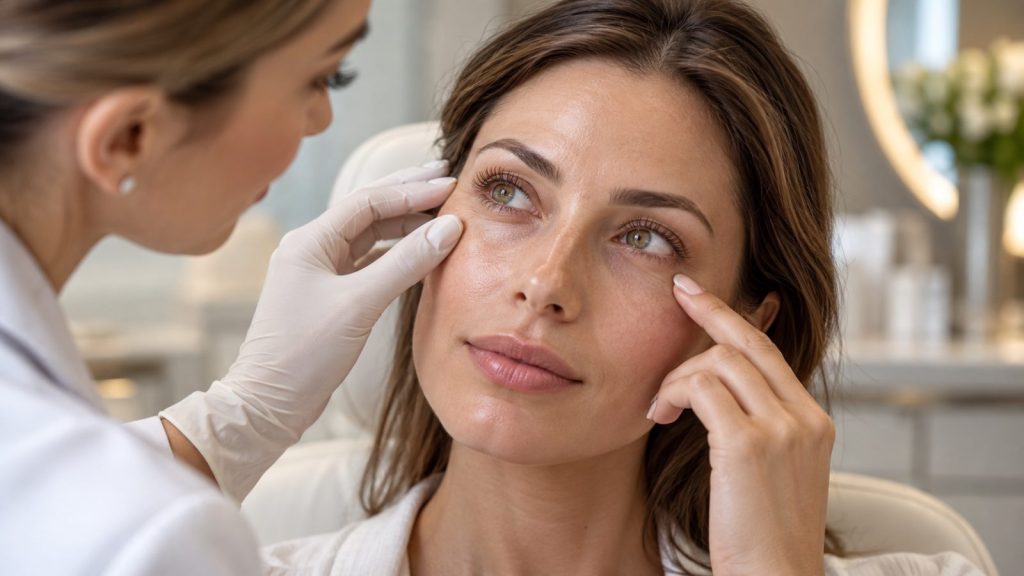
Polynucleotides under eyes have become one of the most searched injectable skin treatments in aesthetic medicine.
Patients are looking for alternatives to tear-trough filler. They want fresher under-eyes, smoother skin, less crepiness and a more rested appearance – but often without adding obvious volume.
That is where polynucleotides can be interesting.
They are not filler.
They are not Botox.
They are not a surgical eye-bag treatment.
They are injectable skin-quality treatments used to support tissue repair, hydration, elasticity and regenerative skin improvement.
At DRV Clinic London, we assess the under-eye area carefully before recommending any injectable treatment. The concern may be thin skin, pigmentation, hollowing, puffiness, visible vessels, eye bags or loss of midface support. These are different problems.
The treatment should follow the diagnosis.
Quick Answer: Are Polynucleotides Good for Under-Eyes?
Polynucleotides under eyes may be suitable for selected patients with thin, crepey, tired-looking or poor-quality under-eye skin.
They may help improve skin quality, hydration, elasticity, fine lines and overall texture.
However, they do not work like tear-trough filler. They do not simply fill a hollow. They do not remove eye bags. They should not be promised as a cure for every type of dark circle.
The under-eye area is complex, and the correct treatment depends on what is causing the concern.
What Are Polynucleotides?
Polynucleotides are injectable products containing purified chains of nucleotides.
In aesthetic medicine, they are used as regenerative skin-quality injectables. Their purpose is not mainly to reshape the face or create projection. Instead, they are used to support the skin environment and improve tissue quality over time.
Patients often hear them described as “salmon DNA injections”. This phrase is popular online, but it is not always helpful.
Some polynucleotide products use highly purified DNA-derived material from salmon or trout. The material is processed and purified before use. Different products are not identical, so patients should know which product is being used, why it is being selected and what it is expected to achieve.
For the broader treatment category, see our Polynucleotides London page.
Why Are Polynucleotides Used Under the Eyes?
The under-eye area is delicate.
The skin is thin. The anatomy is complex. The blood supply, lymphatic drainage and surrounding fat pads all influence the final appearance.
Many patients do not simply have “dark circles”. They may have a combination of thin skin, fine lines, crepey texture, visible blood vessels, pigmentation, tear-trough hollowing, eye bags, fluid retention, midface volume loss, skin laxity and shadowing from anatomy.
Polynucleotides under eyes are mainly considered when skin quality is a major part of the problem.
They may be appropriate when the under-eye skin looks thin, tired, crepey or fragile, but the patient does not necessarily need volume replacement.
Polynucleotides Under Eyes vs Tear-Trough Filler
This is the comparison patients need to understand.
Tear-trough filler is used to improve selected structural hollowing. It can help in carefully chosen patients where the hollow is caused by volume deficiency or anatomical shadowing.
Polynucleotides are used more for skin quality. They do not fill the hollow in the same way.
Concern | More likely option |
Thin, crepey under-eye skin | Polynucleotides may be considered |
Fine lines and poor texture | Polynucleotides may be considered |
True structural tear-trough hollow | Tear-trough filler may be considered |
Eye bags or fat pads | Surgical or other assessment may be needed |
Pigmented dark circles | Dermatology/skincare/laser-type strategy may be discussed |
Fluid retention or puffiness | Filler may be unsuitable in some cases |
This is why an under-eye consultation should not begin with the question: “Do you want filler or polynucleotides?”
It should begin with: “What is actually causing the tired appearance?”
Can Polynucleotides Treat Dark Circles?
Sometimes they may improve the appearance of the under-eye area, but polynucleotides dark circles is not one simple diagnosis.
Dark circles can be caused by pigmentation, thin skin, visible vessels, hollowing, eye bags, fluid retention, shadowing, genetics, allergies, sleep and lifestyle factors, and loss of cheek support.
If dark circles are caused mainly by thin, poor-quality skin, polynucleotides may be helpful in selected patients.
If they are caused mainly by pigmentation, a skin or dermatology-led strategy may be more relevant.
If they are caused by structural hollowing, filler or facial support may be discussed.
If they are caused by eye bags, polynucleotides will not remove the anatomical fat pad.
The diagnosis matters more than the product.
Do Polynucleotides Remove Eye Bags?
No. They should not be sold as a treatment that removes anatomical eye bags.
Eye bags are often caused by fat-pad protrusion, fluid retention, anatomy or age-related tissue changes. Improving the surrounding skin may help the area look fresher in selected patients, but it will not physically remove a true eye bag.
For significant eye bags, surgical opinion may sometimes be more appropriate.
Do Polynucleotides Fill Under-Eye Hollows?
Not like filler.
Polynucleotides are not normally used to fill a hollow in the way that hyaluronic acid tear-trough filler may.
If a patient has a clear structural hollow, tear-trough filler may be considered, but only in carefully selected cases. The under-eye area is prone to swelling, contour irregularity and Tyndall effect when filler is not appropriate.
Polynucleotides may improve the quality of the skin over the hollow, but they should not be expected to replace lost volume in the same way as filler.
Polynucleotides Under Eyes vs Profhilo Under Eyes
Patients often compare Profhilo under eyes with polynucleotides.
Profhilo is a hyaluronic-acid skin-remodelling injectable, more commonly associated with hydration, elasticity and broader skin-quality improvement.
Polynucleotides are more often discussed for regenerative skin-quality support and delicate areas such as the under-eyes.
For many under-eye concerns, polynucleotides may be more relevant than Profhilo, especially when the issue is thin or crepey skin.
However, neither treatment should be chosen just because it is trending.
For the wider comparison, see our Profhilo vs Polynucleotides guide.
Polynucleotides Under Eyes vs Skin Boosters
“Skin booster” is a broad term.
Some skin boosters are HA-based and focus on hydration. Polynucleotides are different. They sit more within a regenerative skin-quality category.
A patient with dry, dehydrated skin may respond well to HA-based hydration treatment.
A patient with thin, crepey under-eye skin may be better suited to a regenerative approach.
A patient with volume loss may need neither.
The under-eye area should be assessed anatomically, not treated automatically with whatever injectable is currently fashionable.
What Results Can You Expect?
Results from polynucleotide eye treatment are usually gradual.
Patients may notice improvement in skin texture, fine lines, crepiness, hydration, elasticity, under-eye freshness and overall skin quality.
The result is not instant reshaping.
You should not expect the under-eye area to look filled immediately after treatment. Polynucleotides work more through progressive skin-quality improvement.
For this reason, before-and-after assessment should be done carefully, ideally with consistent lighting and photographs.
How Many Sessions Are Needed?
The number of sessions depends on under-eye skin thickness, degree of crepiness, fine lines, hydration, pigmentation, age, lifestyle factors, previous treatments, product used and clinical response.
Many patients need a course of treatments rather than one single session.
At DRV Clinic, the treatment plan is decided after consultation rather than using the same protocol for every patient.
Is There Downtime?
Downtime is usually limited, but the under-eye area can swell and bruise more easily than other parts of the face.
Possible short-term effects include small injection marks, redness, swelling, bruising, tenderness, temporary bumps, mild unevenness and sensitivity.
Because the under-eye area is visible and delicate, patients should consider timing around events.
Bruising can happen even with careful technique.
Are Polynucleotides Under Eyes Safe?
Polynucleotides are generally discussed as skin-quality injectables with a favourable safety profile in appropriate patients, but they are still injectable medical aesthetic treatments.
Possible risks include swelling, bruising, redness, tenderness, temporary bumps, inflammatory reaction, infection, asymmetry and unsatisfactory result.
Product-specific allergy considerations should also be discussed.
No injectable treatment should be described as risk-free.
Who May Be Suitable?
Polynucleotides under eyes may be considered for patients with thin under-eye skin, crepey texture, fine lines, poor skin quality, early ageing changes, dull or tired-looking under-eyes, mild under-eye skin laxity, patients unsuitable for tear-trough filler and patients wanting skin quality improvement rather than volume.
Suitability depends on examination.
Who May Not Be Suitable?
Polynucleotides may not be the right choice if the main issue is prominent eye bags, significant tear-trough hollowing requiring structural correction, marked pigmentation requiring another strategy, fluid retention or malar oedema, active infection or inflammation, unrealistic expectations, desire for instant filling or significant skin laxity requiring surgical assessment.
Sometimes the correct treatment is not an injectable skin treatment.
Sometimes it is filler. Sometimes it is skincare. Sometimes it is surgery. Sometimes it is to do nothing immediately.
Are Polynucleotides Better Than Tear-Trough Filler?
Not universally.
They solve different problems.
Polynucleotides may be more appropriate when the issue is skin quality.
Tear-trough filler may be more appropriate when the issue is carefully selected structural hollowing.
In some patients, filler can make the under-eye look worse if the real issue is puffiness, fluid retention, thin skin or poor lymphatic drainage. In others, polynucleotides may not be enough if the hollow is structural.
The right answer depends on diagnosis.
Can Polynucleotides Be Combined With Other Treatments?
Potentially, yes.
Depending on the patient, under-eye polynucleotides may be part of a wider plan involving skincare, pigmentation treatment, Profhilo, skin boosters, dermal filler, Sculptra or other collagen-supporting treatments, Morpheus8 or other energy-based treatments, or surgical referral.
But combination treatment should be planned, not accumulated.
More treatment is not always better treatment.
Why Under-Eye Treatment Needs Caution
The under-eye area is unforgiving.
A small change can make a big difference. Too much volume, poor product choice, swelling, visible product or incorrect diagnosis can make the area look worse rather than better.
This is why we do not recommend choosing under-eye treatment from a tre