
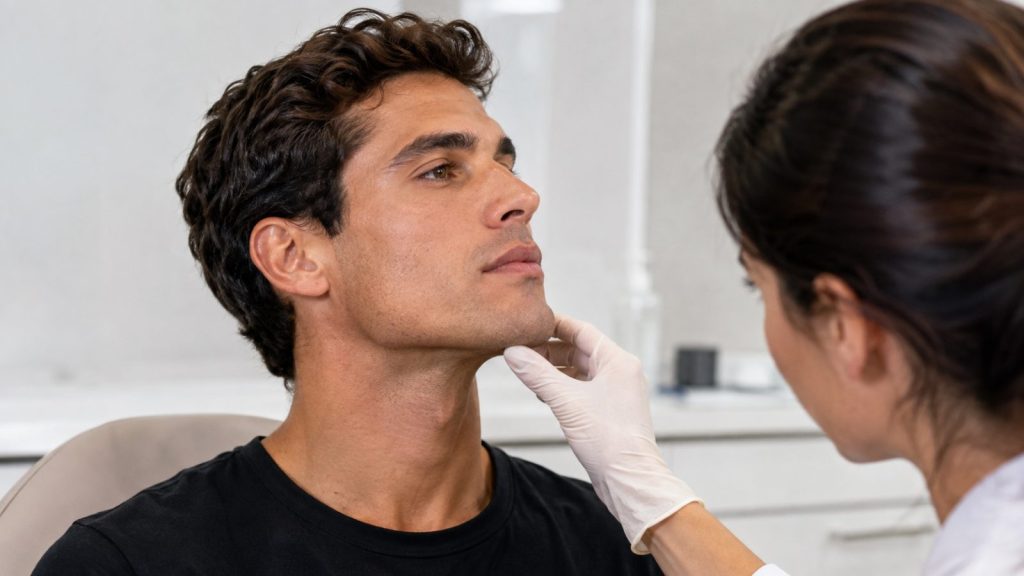
A stronger jawline, more projected chin or more angular facial shape can change the overall impression of the face without altering every individual feature.

That is the principle behind facial masculinisation.


Rather than simply adding large amounts of dermal filler, non-surgical facial masculinisation uses carefully planned changes to facial proportions. The chin, mandibular angle, jawline and cheek structure may all influence whether a face is perceived as softer, more angular or more traditionally masculine.


Facial masculinisation with dermal fillers aims to enhance selected facial proportions associated with a more masculine appearance, commonly by increasing chin projection, strengthening the jawline or altering cheek contour. Treatment should be individualised because there is no single “masculine face” that suits every patient.


At DRV Clinic in Baker Street, facial masculinisation London treatment is planned around existing anatomy, profile, proportions and the patient’s own goals rather than applying the same injection pattern to every face.


This may be relevant to cisgender men who want stronger facial definition, transgender men and non-binary patients seeking more masculine facial characteristics, or anyone who feels that their current proportions do not reflect the appearance they want.


What Is Facial Masculinisation?


Facial masculinisation describes treatments intended to shift facial proportions towards characteristics more commonly associated with a masculine facial appearance.


Surgical facial masculinisation can involve procedures that alter bone and soft tissue permanently.


Non-surgical treatment uses injectables, most commonly dermal fillers, to make more temporary and adjustable changes.


Potential treatment areas include:

The chin.

Jawline.

Mandibular angles.

Cheeks.

Temples.

Forehead or brow region in carefully selected cases.


The aim is not simply to make every feature larger.


A successful treatment should consider how all of these structures relate to one another.


For patients specifically considering this approach, DRV Clinic provides a dedicated facial masculinisation treatment in London.


What Makes a Face Look More Masculine?


There is substantial individual variation, and ideas of masculinity also differ across cultures and between patients.


From an anatomical perspective, research discussing male facial aesthetics commonly identifies characteristics such as:

A broader or more defined lower face.

A stronger mandibular angle.

Greater chin projection.

A relatively wider or squarer chin.

More angular rather than rounded facial contours.

Different patterns of cheek projection.

A flatter or lower eyebrow position.

A more prominent brow and forehead structure.


Research into male injectable treatment emphasises that the male face should not simply be treated using the same proportions typically pursued in female facial aesthetics.


For example, a 2022 review of male injectable treatments notes that a squarer jawline and different cheek projection may contribute to conventionally masculine proportions.

However, these are general anatomical principles, not rules.


The objective of treatment should be to create the degree of masculinity the individual patient wants while maintaining facial harmony.


Why Are the Chin and Jawline So Important?


The lower third of the face has a particularly strong influence on facial shape.

Viewed from the front, the width and definition of the mandibular angles contribute to whether the lower face looks narrow, tapered, oval or square.


Viewed from the side, chin projection helps determine the relationship between the nose, lips and lower face.


This is why male jawline filler and male chin filler are often central to non-surgical facial masculinisation.


Published medical literature on lower-face enhancement similarly identifies the chin and mandibular contour as important contributors to facial harmony and sexual dimorphism.


A recent 2026 systematic review of injectable chin augmentation found that fillers can improve chin projection in appropriately selected patients, although the authors also noted that the available research remains heterogeneous and longer-term comparative evidence is limited.


How Does Chin Filler Masculinise the Face?


The chin occupies a relatively small area, yet even modest changes can influence the whole profile.


In facial masculinisation, filler may potentially be used to:

Increase forward projection.

Increase chin width.

Create a squarer lower-chin contour.

Improve the relationship between the chin and lips.

Balance the side profile.

Reduce the appearance of a retruded chin.

This is why chin filler for men should not simply mean injecting more filler than would be used in a female patient.

The direction of projection matters just as much as volume.


An overly narrow, pointed or excessively projected chin may move the face away from the intended masculine proportions.


Before treating the chin in isolation, the nose, lips, jawline and overall facial height should also be considered.


DRV Clinic’s wider approach to advanced facial harmonisation in London considers these relationships across the whole face rather than looking at each feature independently.


How Does Jawline Filler Create a More Masculine Appearance?


A defined jawline is one of the facial characteristics commonly associated with a more angular appearance.


Dermal filler can be placed strategically to modify selected parts of the lower face.


Depending on anatomy, this can involve:

Strengthening the mandibular angle.

Increasing lateral width.

Improving the transition between the chin and jawline.

Reducing the appearance of a weak mandibular contour.

Creating a straighter line between the chin and angle of the jaw.


For jawline filler men may therefore be less about producing a sharply contoured Instagram-style jaw and more about creating sufficient width and structural support for the person’s facial proportions.


A medical review of non-surgical jawline rejuvenation emphasises the importance of understanding regional anatomy and assessing the entire lower face before performing filler treatment.


That assessment matters because an indistinct jawline is not always caused by inadequate bone structure.


Skin laxity, facial fat, jowling and chin position can all influence the result.


What Role Do the Cheeks Play?


Cheek treatment in facial masculinisation requires particular restraint.


A common mistake is assuming that more prominent cheekbones always create a more masculine face.

They do not.

The location and direction of projection matter.


Medical literature discussing male injectable aesthetics suggests that male cheek enhancement often benefits from maintaining more angular proportions rather than creating excessive anterior or high lateral fullness.


In some patients, carefully planned cheek filler may help create stronger mid-face structure or improve the relationship between the cheeks and lower face.

For another patient, cheek filler may not be needed at all.


This is why male facial fillers should be planned as a facial system rather than as a menu where every possible area receives product.


Facial Masculinisation vs Facial Balancing


These concepts overlap, but they are not identical.

Facial balancing London treatments generally aim to improve proportion between features without necessarily moving the appearance in a specifically masculine or feminine direction.


Facial masculinisation has a more defined aesthetic objective.

For example, facial balancing might involve improving the relationship between a nose and retruded chin.


Facial masculinisation might involve the same chin correction while also considering whether more width through the mandibular angles would support the desired appearance.

Both approaches require looking at the face as a whole.


You can read more about DRV Clinic’s advanced facial harmonisation treatment if your main concern is proportion rather than specifically creating more masculine facial characteristics.


Does Facial Masculinisation Always Require Full-Face Filler?


No.

More treatment is not automatically better treatment.

A patient may need only chin enhancement.

Another may primarily benefit from jawline treatment.


Someone else may require a staged approach involving the chin first and mandibular angles later.


The amount of filler required also cannot be determined accurately from a generic online package.


Facial size, skeletal structure, asymmetry, soft-tissue thickness and treatment goals all influence the plan.


This is particularly important in male facial aesthetics because achieving stronger features can sometimes require more structural change, but excessive filler can quickly make the lower face look heavy or unnatural.

The objective is proportion.

Not maximum volume.


Facial Masculinisation Before and After: What Should Change?


Good facial masculinisation before and after results should still look recognisably like the same person.


Depending on treatment, visible changes might include:

A stronger side profile.

More chin projection.

A broader or squarer chin.

Greater definition through the mandibular angles.

A straighter jawline.

Improved facial symmetry.

More angular cheek structure.

Better proportional balance between the upper, middle and lower thirds of the face.

The exact result depends on anatomy.


Before-and-after images should therefore demonstrate what is possible in another patient, not guarantee how your own face will respond.


Lighting, head position, facial expression and camera distance can also substantially change how jawline and chin results appear in photographs.


How Quickly Do Facial Masculinisation Results Appear?


When hyaluronic acid dermal filler is used, much of the structural change can be seen immediately.

However, the appearance directly after treatment is not the final result.


Temporary swelling can make the chin, jawline or cheeks appear fuller than they ultimately will.

Bruising or local tenderness may also temporarily affect the appearance.


Once swelling settles, the result can be assessed more accurately.

If several areas require treatment, a staged approach may sometimes be preferable to attempting to create the final result during one very large appointment.


How Long Does Facial Masculinisation with Filler Last?


Dermal filler is temporary.


How long results remain visible depends on multiple factors, including:

The filler product.

Treatment area.

Amount used.

Injection depth.

Facial movement.

Individual metabolism.

Anatomy.

Future ageing.


There is therefore no responsible single duration that applies to every jawline, chin and cheek treatment.


Some structural fillers can remain noticeable for many months, but maintenance should be based on how the face actually changes rather than automatically repeating treatment on a fixed date.


Is Facial Masculinisation Permanent?


Non-surgical facial masculinisation with hyaluronic acid filler is not permanent.

That can be an advantage for some patients.


Facial goals can change, and an adjustable treatment allows the result to be developed gradually.


Many hyaluronic acid fillers can also be dissolved with hyaluronidase when clinically appropriate, although dissolving filler is itself a medical procedure and should not be treated as an effortless “undo button”.

Permanent structural changes generally require surgical approaches.


Facial Masculinisation with Filler vs Surgery


Surgical and non-surgical facial masculinisation have fundamentally different capabilities.


Dermal Fillers

Fillers can alter soft-tissue contour and create additional projection or width without cutting bone.

Advantages can include:

No surgical incision.

Immediate structural change.

Relatively limited recovery.

Ability to develop the result gradually.

Temporary and adjustable results.

However, filler cannot physically enlarge or reposition facial bones.


Surgery

Surgical facial masculinisation can make more substantial structural changes.

Depending on the patient, procedures may alter the chin, jaw, forehead or other skeletal structures.

Surgery may therefore be more appropriate when a patient requires major anatomical change that injectable treatment cannot realistically produce.

The trade-off is a more invasive procedure, greater recovery and different risks.

It is misleading to present fillers as a replacement for surgery in every patient.

They provide a different level and type of correction.


Is Jawline Filler Enough for Facial Masculinisation?


Sometimes.

If the jawline is the main anatomical feature preventing the desired appearance, isolated treatment may be appropriate.

But there is an important trap.


Strengthening the mandibular angles without considering a retruded or narrow chin can sometimes exaggerate imbalance.


Likewise, aggressively widening a jawline on a relatively narrow mid-face may not create a harmonious result.


This is why the chin and jaw should usually be assessed together.

A successful lower-face plan considers both frontal and side-profile proportions.


What If My Chin Is the Main Problem?


For some patients, the chin has greater visual impact than the jawline.


A retruded chin can:

Make the nose appear more prominent.

Reduce lower-face definition.

Make the area beneath the chin look fuller.

Weaken the side profile.

Create disproportion between the lips and lower face.


In these cases, chin enhancement can sometimes produce a significant improvement without treating the entire jawline.


The newest systematic review of injectable chin augmentation, published in August 2026, assessed 11 studies involving 876 patients and found generally high satisfaction following injectable volumetric treatment, while also highlighting limitations in the quality and comparability of the evidence.


Can Facial Masculinisation Be Used for Transgender Men?


Yes.

Non-surgical facial masculinisation may be considered by transgender men and some non-binary individuals who want selected facial features to appear more masculine without—or before—undergoing surgical treatment.


A medical review specifically examining non-surgical facial masculinisation and feminisation identifies jawline, chin and supraorbital augmentation among potential injectable approaches used in masculinisation.


The treatment objective should be determined by the patient.

Not every transgender man wants the same facial proportions, just as not every cisgender man wants a broad jaw or square chin.


Consultation should therefore focus on the person’s individual goals without imposing a predetermined idea of what their gender expression should look like.


What Are the Risks of Facial Masculinisation Fillers?


Dermal filler treatment can cause temporary injection-related effects such as:

Swelling.

Bruising.

Redness.

Tenderness.

Asymmetry.

Temporary lumpiness or firmness.

Overcorrection and unwanted contour are also possible.

More serious complications can occur.


Dermal filler can inadvertently enter or obstruct a blood vessel, producing vascular occlusion. Depending on the vessel involved, consequences can include skin injury and, very rarely, visual complications.


These risks are why facial fillers should be treated as medical aesthetic procedures rather than simply cosmetic beauty treatments.


Knowledge of anatomy, appropriate injection technique, product selection and the ability to identify and manage complications all matter.


Can Too Much Filler Make a Male Face Look Less Masculine?


Yes.

More filler does not necessarily produce a stronger-looking face.


Overfilling the cheeks can soften angular contours.

Too much jawline filler can create heaviness.

An overly projected chin can look disproportionate.

Excessive width may disturb the relationship between the lower face and temples.


This is why a staged treatment can sometimes be preferable.

It is easier to add carefully considered volume later than to correct an unnecessarily aggressive initial treatment.


Does Facial Masculinisation Look Natural?


It can.

Natural-looking masculinisation should enhance the patient’s existing structure rather than create a completely unrelated face.


This is particularly important because masculine proportions should not be reduced to one template.


Some patients want only slightly better chin projection.

Others want a visibly broader lower face.

Others may primarily want their facial appearance to align more closely with their gender identity.


A natural result therefore means that the treatment fits both the patient’s anatomy and the result they personally want.


How Much Does Facial Masculinisation Cost in London?


There is no single fixed cost because facial masculinisation with fillers can involve very different treatment plans.


One patient may require chin filler only.

Another may need treatment across the chin and jawline.

A broader facial plan may also involve the cheeks or other areas.


DRV Clinic’s current price list includes individual options for chin, cheek and jawline filler, with pricing varying according to the treatment area, amount of product and practitioner.


You can check the latest fees on our DRV Clinic treatment prices page.


The amount of filler should be decided according to anatomy rather than selecting the largest package in advance.


Facial Masculinisation at DRV Clinic in Baker Street


DRV Clinic provides non-surgical facial masculinisation in London from 1st Floor, 136 Baker Street, London W1U 6UD, in Marylebone.


Assessment considers the face from both the front and side, including:

Chin projection and width.

Jawline definition.

Mandibular angle.

Cheek structure.

Facial symmetry.

Relationship between the nose, lips and chin.

Soft-tissue volume.

The patient’s preferred degree of masculinisation.


Where the main concern is general facial proportion rather than specifically masculine characteristics, advanced facial harmonisation may provide the more appropriate treatment framework.


Patients considering individual areas can also learn more about dermal fillers in London.


The purpose of consultation is not to identify every possible place where filler could be injected.


It is to decide which changes, if any, would meaningfully improve the proportions the patient wants.


To discuss your treatment goals privately, contact DRV Clinic in Baker Street to arrange a consultation.

Frequently Asked Questions

Facial masculinisation involves changing selected facial proportions so features appear more traditionally masculine. Non-surgical treatment commonly uses dermal fillers to enhance areas such as the chin and jawline.

Common areas include the chin, jawline, mandibular angles and cheeks. Not every patient requires treatment in all of these areas.

Yes, in appropriately selected patients. Filler can increase chin projection, strengthen the jawline or alter facial contour, all of which can influence how masculine facial proportions are perceived.

There is no single best treatment plan. Jawline filler may help when inadequate contour or width is the primary concern, but chin position, soft tissue and the rest of the face should also be assessed.

The chin can have a major influence on male facial proportions, particularly from the side. Increasing projection or width may improve facial balance in patients with a small or retruded chin.

Yes. Dermal fillers can make temporary changes to chin, jawline and selected facial contours without surgery. They cannot reproduce the degree of skeletal change possible with facial surgery.

It may be. Non-surgical masculinisation can be considered by transgender men and non-binary patients who want more masculine facial characteristics. Treatment should always reflect the individual's own goals.

There is no standard amount. Requirements depend on facial size, skeletal structure, treatment areas, existing proportions and the degree of change requested.

Structural changes from hyaluronic acid filler are generally visible immediately, although swelling can temporarily distort the early result. The final appearance should be assessed once the tissues have settled.

Duration varies according to product, treatment area, amount, metabolism and anatomy. Dermal filler is temporary and maintenance requirements differ between patients.

Many hyaluronic acid fillers can be dissolved using hyaluronidase when clinically appropriate. This is itself a medical procedure and does not eliminate the need for careful initial treatment planning.

Not exactly. Facial balancing aims to improve overall proportion, while facial masculinisation specifically seeks to move selected proportions towards a more masculine appearance. The two approaches can overlap.

Medical References


  1. Shome D, Bose D, Prabhughate A, et al. Injectable Filler-Based Chin Augmentation: A Systematic Review of Non-Surgical Volumetric Techniques. Aesthetic Plastic Surgery. 2026. This systematic review analysed 11 studies involving 876 patients and examined the effectiveness, safety and patient satisfaction associated with injectable chin augmentation. Read the study on PubMed
  2. Yanes DA, Keaney TC. Refining Male Injectables in Aesthetics. Clinics in Dermatology. 2022;40(3):256–258. This review discusses anatomical and aesthetic considerations that distinguish injectable treatment planning in male patients, including jawline and cheek proportions. Read the study on PubMed
  3. Keaney TC, Anolik R, Braz A, et al. The Male Aesthetic Patient: Facial Anatomy, Concepts of Attractiveness, and Treatment Patterns. Journal of Drugs in Dermatology. 2018;17(1):19–28. This review examines anatomical differences, facial proportions and treatment objectives relevant to male aesthetic patients. Read the study on PubMed
  4. Rossi AM, Fitzgerald R, Humphrey S. Facial Soft Tissue Augmentation in Males: An Anatomical and Practical Approach. Dermatologic Surgery. 2017;43:S131–S139. The review describes anatomical considerations and a pan-facial approach to soft-tissue augmentation in men. Read the study on PubMed
  5. Bertucci V, et al. Reshaping the Lower Face Using Injectable Fillers. This medical review discusses chin, mandibular angle and jawline treatment, including the role of the lower facial third in facial proportions and sexual dimorphism. Read the study on PubMed
  6. Moradi A, Shirazi A, David R. Nonsurgical Jawline Rejuvenation Using Injectable Fillers. Journal of Cosmetic Dermatology. 2020. This review examines jawline anatomy, patient assessment, gender considerations and complications associated with injectable jawline augmentation. Read the study on PubMed
  7. Choi MS, et al. Using Injectable Fillers for Chin and Jawline Rejuvenation. World Journal of Otorhinolaryngology – Head and Neck Surgery. 2023;9(2):131–137. This review discusses filler types, anatomy, indications, limitations and complications associated with lower-face injectable treatment. Read the full article on PubMed Central
  8. Morrison SD, Vyas KS, Motakef S, et al. Nonsurgical Management of Facial Masculinization and Feminization. This review considers injectable options for non-surgical facial gender affirmation, including chin, jawline and supraorbital augmentation for facial masculinisation. Read the study on PubMed


This article is intended for general educational information and does not replace an individual medical consultation. Dermal filler treatment carries potential risks and is not suitable for every patient.