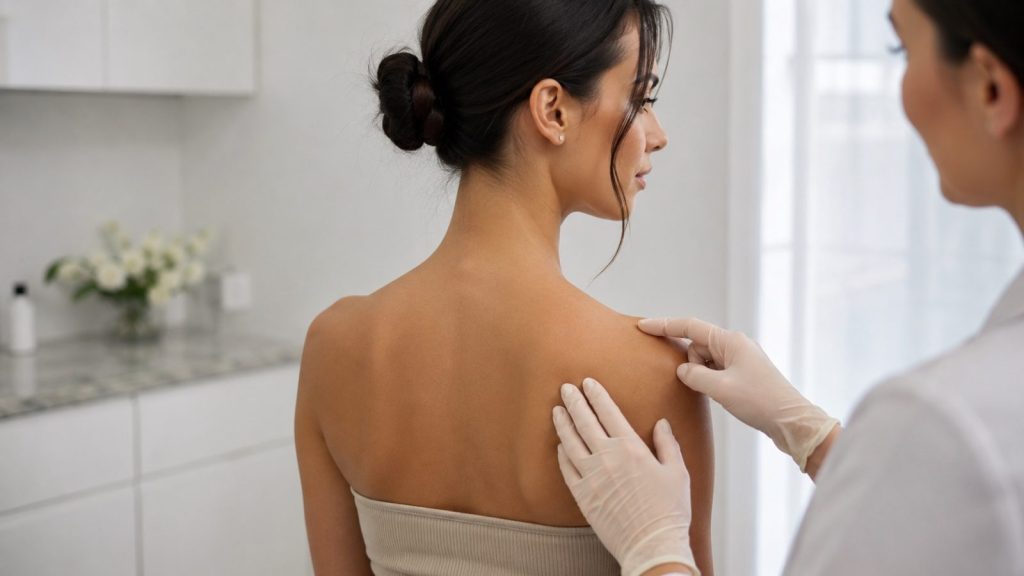
The term barbie botox has become increasingly visible online, usually alongside photographs showing a longer-looking neck and a smoother, more sloping transition from the neck to the shoulders.


Behind the social-media name is a real medical-aesthetic technique: botulinum toxin injections into the upper trapezius muscles.

It is also known as trapezius botox, trap botox, shoulder botox or traptox.


The principle is relatively straightforward. Botulinum toxin temporarily reduces activity within selected parts of the trapezius muscle. Over time, reduced muscle activity can lead to a reduction in muscle bulk, potentially making prominent upper trapezius muscles appear less bulky and changing the contour between the neck and shoulders.


Trapezius botulinum toxin does not lengthen the neck or alter the shoulder bones. Its cosmetic effect comes primarily from temporarily reducing upper trapezius muscle activity and, in suitable patients, gradually reducing muscle thickness and prominence.


This distinction matters because not every broad or elevated-looking shoulder is caused by a large trapezius muscle.


At DRV Clinic in Baker Street, patients considering barbie botox london treatment are assessed to establish whether trapezius hypertrophy is actually contributing to the appearance before treatment is considered.


What Is Barbie Botox?


Barbie Botox is the popular name given to aesthetic botulinum toxin treatment of the upper trapezius muscles.


The treatment became widely discussed because reducing trapezius prominence can make the shoulder line appear more gently sloped and may visually increase the apparent distance between the neck and shoulders.

However, “Barbie Botox” is not a separate medicine.


Botox is a brand name for one formulation of botulinum toxin type A. Other botulinum toxin products also exist, and their doses are not automatically interchangeable.

The more medically accurate description is trapezius botulinum toxin treatment.


At DRV Clinic, this treatment appears on our current treatment price list as Trapezius Botox / Shoulder Botox / Barbie Neck.


What Is the Trapezius Muscle?


The trapezius is a large superficial muscle extending across the upper back, neck and shoulders.


It has several functional regions and contributes to important movements involving the shoulder blade, neck and upper limb.


The upper fibres of the trapezius help with movements including elevation and positioning of the shoulder girdle.

Some people naturally have prominent trapezius muscles.


Muscle size can also be influenced by:

Genetics.

Resistance training.

Posture and habitual movement.

Occupational activity.

Sport.

Individual anatomy.


In some patients, relatively bulky upper trapezius muscles create a more elevated or square-looking shoulder contour.

That is the anatomical concern trapezius botox attempts to modify.


How Does Trapezius Botox Work?


Botulinum toxin type A reduces the release of acetylcholine at the neuromuscular junction.


In simpler terms, it temporarily weakens signalling between the nerve and the targeted muscle.


When carefully injected into selected areas of the upper trapezius, muscle contraction decreases.

With reduced activity over time, the treated muscle may become thinner.


This is different from facial anti-wrinkle treatment, even though the medication works through the same basic mechanism.


When treating forehead lines, the objective is usually to reduce movement sufficiently to soften dynamic wrinkles.


With botox shoulders treatment, reducing muscle bulk itself is an important part of the cosmetic objective.


Published clinical research has demonstrated measurable reductions in trapezius muscle thickness following botulinum toxin treatment.


Does Barbie Botox Actually Make the Neck Look Longer?


It can make the neck appear longer in suitable patients.

It does not anatomically lengthen the cervical spine.


The visual effect occurs because a prominent upper trapezius can create a steeper transition from the neck towards the shoulders.


If muscle bulk is reduced, the shoulder contour may become less elevated, which can visually expose more of the neck.


This can create the impression of:

A longer neck.

More sloping shoulders.

A softer neck-to-shoulder transition.

Reduced trapezius prominence.

A more delicate upper-body contour.

The effect depends heavily on baseline anatomy.


Someone with naturally broad clavicles or skeletal shoulder width will not suddenly develop narrow shoulders because the trapezius has been treated.


Does Trapezius Botox Make the Shoulders Smaller?


Does trapezius botox make shoulders smaller? It can reduce the visible bulk contributed by enlarged trapezius muscles.


A 2023 randomised controlled trial assessed two botulinum toxin injection techniques for trapezius hypertrophy. Researchers found reductions in trapezius thickness and changes in shoulder contour, with greater reductions using a nerve-distribution-based injection method at later follow-up.


A more recent 2026 prospective randomised trial also found statistically significant reductions in trapezius area 12 weeks after treatment.


This provides objective evidence that treatment can alter muscle dimensions.

However, shoulder size is determined by much more than the trapezius.


Clavicle width, skeletal structure, deltoid size, body fat and overall upper-body musculature all influence appearance.


The treatment therefore changes one component of shoulder contour rather than shrinking the entire shoulder girdle.


Who Might Benefit from Trapezius Botox?


Trapezius botox london treatment may be considered when prominent upper trapezius muscle bulk is contributing to the patient’s concern.


Potential candidates may notice:

A bulky transition between the neck and shoulders.

Prominent upper trapezius muscles.

A square or elevated-looking shoulder line.

Asymmetry in upper trapezius prominence.

A desire for a softer shoulder contour without surgery.


The most important factor is whether the muscle itself is the anatomical cause.

A consultation should also consider physical activity and functional requirements.


The trapezius is not an unnecessary cosmetic structure. It plays an important role in shoulder movement and stability.

Deliberately weakening it therefore requires appropriate patient selection and dosing.


Who May Not Be Suitable?


Aesthetic trapezius treatment is not appropriate for everyone who wants narrower-looking shoulders.


Broad Skeletal Shoulders

Botulinum toxin does not change clavicle length or bone structure.

Someone with naturally broad skeletal proportions may achieve relatively little change.


Prominent Deltoid Muscles

If the outer shoulder width primarily comes from the deltoid rather than the trapezius, treating the trapezius will not adequately address that concern.


Significant Body Fat

Muscle reduction will not reproduce the effect of body-fat reduction where soft tissue rather than muscle is driving the contour.


Existing Shoulder Weakness

Weakening an already compromised muscle may be inappropriate.


Certain Neuromuscular Conditions

Botulinum toxin requires particular caution in people with disorders affecting neuromuscular transmission.

Medical history therefore matters.


Unrealistic Expectations

The treatment cannot create an entirely different skeletal frame.

It is intended to produce a relatively subtle contour change.


What Do Barbie Botox Before and After Results Look Like?


Good barbie botox results should still look anatomically believable.

The most noticeable difference may be a smoother downward slope from the neck towards the shoulders rather than a dramatic reduction in overall body width.


Possible changes include:

Reduced trapezius prominence.

A softer shoulder contour.

A more visible neck-to-shoulder transition.

A less elevated-looking upper shoulder.

Greater apparent neck length.

Before-and-after photographs should be interpreted carefully.

Shoulder posture can dramatically alter the apparent size of the trapezius.


Someone consciously depressing their shoulders in an “after” photograph can create a misleading difference.


Standardised posture, camera height and arm position are therefore particularly important when evaluating results.


When Does Barbie Botox Start Working?


Botulinum toxin begins affecting muscle activity before the full aesthetic contour change develops.


This creates two separate timelines.

Muscle weakening begins first.

Visible muscle reduction develops later.


A patient may therefore feel that the trapezius behaves differently before there is a substantial visible change in shoulder contour.


Clinical studies evaluating aesthetic trapezius treatment often assess outcomes at one month, three months and later rather than expecting the final result after several days.


When Do Trapezius Botox Results Appear?


Visible trapezius botox results develop gradually.

Early changes may begin becoming apparent during the first few weeks as muscle activity decreases.


More noticeable changes in muscle thickness and shoulder contour may develop over approximately one to three months.


A 2025 imaging study of patients treated for bilateral trapezius hypertrophy identified significant reductions in muscle surface area at one month, three months and six months after treatment.


A 2023 randomised controlled trial similarly measured changes at one, three and six months.


This means barbie botox should not be judged using photographs taken a few days after treatment.


The principal contouring effect takes time.


What Is the Barbie Botox Results Timeline?


Individual responses vary, but the general process can be understood as follows.


First Few Days

Injection-site tenderness, bruising or mild discomfort may occur.

The shoulder shape will generally look much the same.


Around 1–2 Weeks

Botulinum toxin activity becomes more established.

Patients may begin noticing a difference in how strongly the treated muscle contracts.


Around 1 Month

Early visible contour changes may become easier to identify.

Clinical studies have demonstrated measurable changes by this stage.


Around 2–3 Months

Muscle reduction may become more noticeable, and this is often a more useful point for judging the aesthetic contour.


Following Months

The effect remains temporary.


Muscle activity gradually returns as neuromuscular signalling recovers, although the precise aesthetic duration varies.


How Long Does Barbie Botox Last?


How long does barbie botox last varies according to the toxin formulation, dose, individual muscle size, metabolism and physical activity.


Several trapezius studies have followed patients for six months, with measurable effects remaining during follow-up.


One randomised controlled study comparing incobotulinumtoxinA and onabotulinumtoxinA reported changes in muscle thickness that remained measurable over a longer follow-up period, although the study was small and the results should not be generalised into a guaranteed duration.


It is therefore more responsible to describe the treatment as temporary rather than promise a fixed number of months.


Patients who heavily train their trapezius may also have different functional and aesthetic requirements from patients who do not.


Does Barbie Botox Hurt?


The treatment involves several injections into the upper trapezius muscles.


Patients may experience:

Brief needle discomfort.

Stinging.

Local tenderness.

Bruising.

Aching around the treatment area.

The procedure is non-surgical, so there are no incisions or stitches.


However, a large muscle is being treated at multiple points, and the injection experience should not be described as completely sensation-free.


What Is the Downtime After Trapezius Botox?


Downtime is generally limited.

Many patients can return to normal routine relatively quickly, although individual aftercare instructions should be followed.


Temporary effects around the injection sites may include:

Tenderness.

Minor bruising.

Redness.

Swelling.

Muscular aching.


Patients may also notice that the shoulder muscles feel different as botulinum toxin activity develops.


Strenuous activity should be discussed with the treating clinician, particularly for patients who regularly train the upper body or rely heavily on shoulder strength professionally.


DRV Clinic provides broader information about botulinum toxin treatment and aftercare on our anti-wrinkle injections in London page.


Can You Exercise After Trapezius Botox?


Patients who regularly train their shoulders should discuss this before treatment rather than only afterwards.


The trapezius contributes to normal movement and shoulder-girdle function.

Reducing its activity is the actual mechanism of treatment.


This makes trap botox different from simply treating a small expression muscle in the face.


Your practitioner may recommend temporarily avoiding strenuous exercise immediately after injections.


Longer term, patients should also understand that intensive trapezius training and deliberately reducing trapezius size have opposing goals.


A patient who wants substantial trapezius hypertrophy for sport or bodybuilding may not be an ideal aesthetic candidate.


Can Trapezius Botox Help Shoulder or Neck Pain?


This should be separated from the cosmetic indication.

Botulinum toxin has been investigated for several pain and muscle-related disorders, including trapezius myalgia and cervical conditions.


Some studies examining trapezius treatment have reported improvement in discomfort as well as reductions in muscle size.


However, having cosmetic shoulder botox is not the same as receiving a medically indicated treatment for chronic neck or shoulder pain.


Pain can arise from many causes, including cervical spine disorders, nerve problems, rotator-cuff pathology, posture-related issues and other musculoskeletal conditions.


Persistent pain needs appropriate assessment rather than assuming that cosmetic botulinum toxin will treat it.


Does Barbie Botox Affect Shoulder Strength?


Potentially.

Botulinum toxin works by reducing muscle activity.


Some localised weakness is therefore part of its pharmacological action rather than an impossible complication.


The objective is to reduce enough upper trapezius activity to influence contour without causing unacceptable functional impairment.


This balance matters particularly for:

Athletes.

Weightlifters.

Swimmers.

People performing frequent overhead work.

People whose occupations require substantial upper-body strength.

Anyone with pre-existing shoulder dysfunction.


Research into trapezius contouring generally reports favourable tolerability in the studied populations, but sample sizes remain comparatively small.


This is not a treatment where more toxin should automatically be interpreted as producing a better cosmetic result.


Why Injection Anatomy Matters


The trapezius is supplied in part by the spinal accessory nerve, and its intramuscular nerve branches follow specific patterns.


Several anatomical studies have mapped these nerve distributions to improve the precision of botulinum toxin injection.


A 2023 randomised controlled trial found that a nerve-distribution-based technique produced greater reductions in trapezius thickness and shoulder contour measurements at later follow-up than a conventional approach.


Separate anatomical research has similarly identified regions of dense nerve arborisation within the upper trapezius.


This supports an important clinical point:

Trapezius treatment should be anatomy-led rather than performed by simply injecting a fixed grid copied from social media.


Muscle size, shoulder asymmetry and functional requirements differ between patients.


What Are the Risks of Barbie Botox?


Potential injection-related effects include:

Pain.

Bruising.

Swelling.

Tenderness.

Temporary local discomfort.


The pharmacological effect can also produce excessive weakness if treatment affects more muscle function than intended.


Official UK botulinum toxin prescribing information recognises muscular weakness as an expected pharmacological consequence and describes rare complications associated with spread of toxin beyond the intended site.


These can include:

Excessive muscle weakness.

Difficulty swallowing.

Speech problems.

Breathing difficulties.


Such serious complications are uncommon but require urgent medical attention.

Patients with certain neuromuscular conditions may be particularly susceptible to systemic effects and require careful medical assessment.


Is Barbie Botox Safe?


Clinical studies of aesthetic trapezius botulinum toxin have generally reported favourable safety findings in the small populations studied.


A 2026 randomised double-blind trial of 20 women with trapezius hypertrophy found significant reductions in muscle area following treatment, without statistically significant differences in complications between the studied dose groups.


A 2023 randomised trial involving 30 women also reported no severe adverse effects.


However, these studies are small.

A treatment does not become risk-free because a social-media name makes it sound casual.


The trapezius is a large functional muscle, and the evidence base for purely aesthetic shoulder contouring remains considerably smaller than that for established facial botulinum toxin indications.


Is Barbie Botox an Approved Cosmetic Use of Botox?


This needs clarification.

“Botox” is frequently used conversationally to describe botulinum toxin treatments, but Botox itself is a specific prescription medicine.

Licensed indications vary according to the product and jurisdiction.


Aesthetic injection of botulinum toxin into the trapezius for shoulder contouring is generally an off-label cosmetic use rather than one of the conventional licensed facial aesthetic indications.


Off-label prescribing is not automatically inappropriate.

Medicines are used outside their licensed indications in many areas of medical practice when a qualified prescriber determines that doing so is clinically appropriate.


However, patients should be told what product is being proposed, why it is being used and the relevant limitations of the evidence.


The NHS confirms that botulinum toxin injections are prescription-only medicines and recommends checking who prescribes the treatment, who performs it and what training and insurance arrangements are in place.


Barbie Botox vs Shoulder Slimming Surgery


These approaches are fundamentally different.

Botulinum toxin does not remove bone or permanently alter the shoulder skeleton.

Its effect is temporary and dependent on reducing muscle activity.


Surgery can create much more significant permanent anatomical change but involves substantially greater intervention, recovery and risk.


For most patients considering barbie botox, the attraction is precisely that the treatment is non-surgical and reversible with time.


That also means expectations should remain proportionate to a temporary muscle-modulating procedure.


Barbie Botox vs Body Contouring


Body-contouring procedures generally target fat, skin or both.

Trapezius botox targets muscle.


Therefore, someone whose upper-body shape is predominantly influenced by body fat will not necessarily obtain the result they want by reducing trapezius activity.


Similarly, technologies designed for skin tightening do not reproduce the muscular effect of botulinum toxin.


Correctly identifying which tissue creates the concern is fundamental to choosing treatment.


Can Men Have Trapezius Botox?


Yes, where clinically appropriate.

The treatment is often marketed using highly feminised terms such as “Barbie Neck”, but botulinum toxin does not have a gender-specific mechanism.


Men with prominent trapezius muscles may also seek a less bulky shoulder-neck transition.


However, male patients may on average have larger or stronger trapezius muscles, and some actively want to preserve upper-body muscularity.


Treatment planning should therefore be based on the individual’s anatomy and goal rather than gender.


Will My Trapezius Grow Back?


Muscle activity gradually returns as the effect of botulinum toxin wears off.

If normal or intensive trapezius activity resumes, muscle bulk can increase again.

This is why the treatment is temporary.


Repeated injections may maintain the aesthetic effect for longer periods in some patients, but there is not yet enough robust long-term evidence to define an ideal cosmetic maintenance schedule for every patient.

Repeat treatment should follow reassessment.


How Much Does Barbie Botox Cost in London?


DRV Clinic currently lists:

Trapezius Botox / Shoulder Botox / Barbie Neck – £350


Current pricing can be checked on the DRV Clinic treatment price list.

The amount of botulinum toxin required can vary because trapezius size and strength differ significantly between patients.


Treatment should therefore be planned according to anatomy rather than simply increasing dose to pursue a more dramatic result.


Barbie Botox at DRV Clinic in Baker Street, London


DRV Clinic provides consultations for trapezius botox london treatment from 1st Floor, 136 Baker Street, London W1U 6UD, in Marylebone.


Assessment considers:

Upper trapezius size.

Shoulder contour.

Left-to-right asymmetry.

Clavicle and skeletal width.

Upper-body training.

Existing shoulder function.

Medical history.


The patient’s desired degree of change.

Dr Razvan Vasilas and the DRV Clinic team assess whether reducing trapezius activity is appropriate before treatment is considered.


Patients should understand that the aim is not to create a completely different shoulder skeleton.


It is to reduce muscle prominence where that prominence is genuinely contributing to the concern.


You can read more about botulinum toxin treatments on our anti-wrinkle injections in London page, review current DRV Clinic prices or contact DRV Clinic in Baker Street to arrange a consultation.

Frequently Asked Questions

Barbie botox is a popular name for botulinum toxin injections into the upper trapezius muscles. Treatment aims to reduce muscle activity and, over time, trapezius bulk so the neck-to-shoulder contour may appear softer.

Trapezius botox involves injecting botulinum toxin into selected areas of the trapezius muscle to temporarily reduce its activity. Aesthetic treatment usually aims to reduce prominent upper trapezius muscle bulk.

It reduces signalling between nerves and the treated muscle. As trapezius activity decreases, muscle thickness may gradually reduce, potentially creating a less bulky shoulder contour.

It does not physically lengthen the neck. Reducing prominent upper trapezius muscles can make the neck appear longer because more of the neck-to-shoulder transition becomes visible.

It may reduce the part of shoulder prominence caused by enlarged trapezius muscles. It cannot change clavicle width or other skeletal dimensions.

Muscle activity begins changing before the full cosmetic result appears. Visible contour changes may begin during the first few weeks and become more noticeable over one to three months.

The treatment is temporary. Studies have reported measurable trapezius changes across several months, but individual duration varies and a fixed cosmetic lifespan cannot be guaranteed.

Multiple injections are required, so brief stinging, tenderness or aching may occur. There are no surgical incisions.

It can. Reducing muscle activity is the intended mechanism of the treatment. Excessive or unwanted weakness is possible, which is why dose, placement and patient selection matter.

Your treating clinician should provide individual advice. Patients who regularly perform heavy upper-body training should discuss their exercise routine before treatment because the trapezius is an important functional muscle.

Botulinum toxin has been researched for some muscular pain conditions, but aesthetic trapezius treatment should not be regarded as a general treatment for neck or shoulder pain. Persistent pain needs appropriate diagnosis.

No. Neuromuscular function gradually recovers and trapezius muscle activity can return.

Medical References


  1. Efficacy and Safety of LetibotulinumtoxinA Injection for Trapezius Hypertrophy: A Prospective, Randomized, Double-Blind Trial. 2026. This prospective randomised study assessed two doses in women with trapezius hypertrophy and demonstrated significant reductions in trapezius area 12 weeks after treatment. Read the study on PubMed
  2. Nerve Distribution Method Is Superior to the Conventional Method in BoNT-A Treatment of Trapezius Hypertrophy: A Randomized Controlled Trial. Aesthetic Plastic Surgery. 2023. This study compared two injection approaches and found greater reductions in trapezius thickness, shoulder area proportion and shoulder angle with a nerve-distribution-based technique at later follow-up. Read the study on PubMed
  3. Park JY, et al. Efficacy and Safety of Incobotulinumtoxin-A for Trapezius Muscle Reduction: Quantitative Evaluation With Imaging Studies. Plastic and Reconstructive Surgery – Global Open. 2025. Imaging analysis demonstrated significant reductions in trapezius surface area at one, three and six months following treatment. Read the study on PubMed
  4. Incobotulinum Toxin A with a One-Year Long-Lasting Effect for Trapezius Contouring and Superior Efficacy for the Treatment of Trapezius Myalgia. This split-shoulder, double-blind randomised trial examined changes in trapezius thickness and symptoms following different botulinum toxin type A formulations. Read the study on PubMed
  5. Yi KH, et al. Anatomical Guide for Botulinum Neurotoxin Injection: Application to Cosmetic Shoulder Contouring, Pain Syndromes, and Cervical Dystonia. Clinical Anatomy. 2021. This anatomical study mapped intramuscular nerve branching within the trapezius to identify relevant regions for botulinum toxin treatment. Read the study on PubMed
  6. Lee JH, et al. Accessory Nerve Distribution for Aesthetic Botulinum Toxin Injections into the Upper Trapezius Muscle: Anatomical Study and Clinical Trial. Surgical and Radiologic Anatomy. 2018. The study investigated accessory-nerve distribution and measured trapezius thickness after aesthetic botulinum toxin injections. Read the study on PubMed
  7. Beyond Wrinkles: A Systematic Review and Meta-analysis of Off-Label Aesthetic Uses of Botulinum Neurotoxin. 2026. This systematic review examined wider aesthetic applications of botulinum toxin beyond conventional facial wrinkle treatment, including non-facial contouring procedures. Read the study on PubMed
  8. AbbVie Ltd. BOTOX Summary of Product Characteristics. UK electronic Medicines Compendium. Official prescribing information describes botulinum toxin’s pharmacological effects and recognised risks, including local muscle weakness and rare effects associated with toxin spread. Read the current UK prescribing information
  9. NHS. Choosing Who Will Do Your Cosmetic Procedure. NHS guidance confirms that botulinum toxin injections are prescription-only medicines and recommends checking the prescriber, injector, training, experience and insurance arrangements before treatment. Read the NHS guidance


This article is intended for general educational information and does not replace an individual medical consultation. Aesthetic trapezius botulinum toxin treatment may involve off-label prescribing, has potential risks and is not suitable for everyone.