Patients usually choose Morpheus8 because they want their face to look firmer, fresher and better supported.
So when the face appears flatter, more hollow or older after treatment, it can be frightening.
Searches such as can Morpheus8 cause fat loss, does Morpheus8 cause fat loss, and does Morpheus8 cause fat loss in face are becoming more common because patients are trying to understand whether RF microneedling can alter facial volume.
The honest answer is: yes, unwanted facial volume change has been reported after RF microneedling treatments. But not every apparent change after Morpheus8 is true permanent fat loss.
This distinction matters.
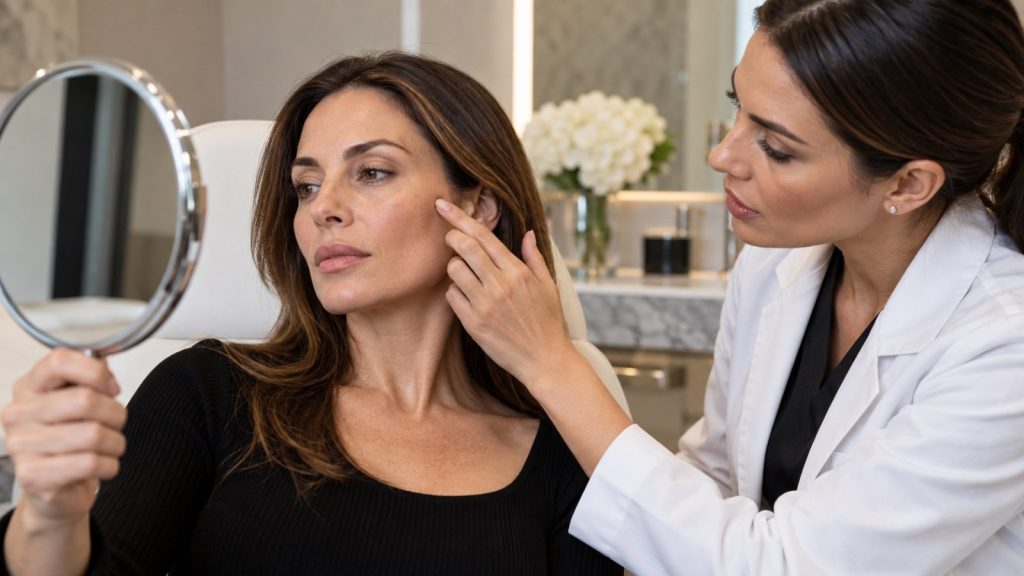
At DRV Clinic London, we assess patients concerned about facial hollowing, volume loss or unexpected changes after Morpheus8 and other RF microneedling treatments, including treatments performed elsewhere.
The first step is not panic.
The first step is diagnosis.
Quick Answer: Can Morpheus8 Cause Fat Loss?
Yes, Morpheus8 fat loss is possible because the treatment uses radiofrequency energy delivered through microneedles into selected tissue depths.
Radiofrequency energy creates heat within tissue. Depending on the depth, energy level, pulse characteristics, number of passes and anatomical area treated, deeper tissue effects may occur.
In some areas, controlled tissue remodelling may be part of the treatment objective. In other areas, especially naturally thin or hollow facial regions, unwanted volume reduction can be a problem.
The face should not be treated as one uniform surface.
The cheeks, temples, under-eye area, lower face and neck all have different anatomy. What may be suitable for one region may be too aggressive for another.
What Does Morpheus8 Fat Loss Look Like?
Patients who are worried about RF microneedling fat loss may describe:
- cheeks looking flatter
- new hollowing beneath the cheekbones
- under-eye hollows becoming more visible
- temples looking more sunken
- more visible facial bones
- uneven facial contours
- new asymmetry
- skin looking looser after losing support
- a more tired appearance
- the face looking older, not younger
Sometimes these changes appear gradually rather than immediately.
Immediately after Morpheus8, swelling and inflammation can temporarily make the face look fuller. As swelling settles, the true facial contour becomes easier to judge. This is why the timeline is important.
Is It Definitely Fat Loss?
Not always.
This is one of the most important points.
A face can look different after Morpheus8 for several reasons, including swelling resolving, dehydration, weight loss, different lighting, different camera angle, changes in skincare, natural ageing, pre-existing asymmetry becoming more noticeable, skin tightening changing shadows, or actual volume reduction.
A proper assessment should not diagnose fat loss from one photograph alone.
Before assuming permanent damage, it is important to compare the full clinical picture: before photos, after photos, treatment settings, areas treated, number of sessions, weight changes and the timeline of the change.
Why Can RF Microneedling Affect Facial Fat?
Morpheus8 combines microneedling with radiofrequency energy.
The needles enter the skin at selected depths. RF energy is then delivered into tissue, creating heat. Depending on the settings and treatment area, this heat may affect different tissue layers.
Important variables include needle depth, energy level, number of passes, treatment overlap, pulse characteristics, thickness of the treated tissue, anatomical area, amount of existing facial fat, previous filler or energy-based treatments and individual healing response.
The principle is simple:
A setting that may be reasonable for thicker tissue or lower-face remodelling may not be appropriate for a naturally slim cheek, temple or under-eye region.
Technology should follow anatomy.
Anatomy should never follow a preset machine protocol.
Facial Fat Is Not the Enemy
In aesthetic medicine, fat is often discussed as something to reduce.
But facial fat is not automatically a problem.
Healthy facial volume plays a major role in youthful facial architecture. It supports the skin, softens shadows and helps maintain facial balance.
When too much volume is lost, the face may look hollow, tired, skeletal, sharper in the wrong way, older, less supported and less healthy.
This is why aggressive “tightening” or “contouring” is not always appropriate.
A youthful face is not simply a tight face.
It is a balanced relationship between skin, fat, ligaments, muscle and bone.
Who May Be More Vulnerable to Unwanted Volume Loss?
Every patient needs individual assessment, but more caution may be appropriate in patients with:
- naturally slim faces
- low facial fat volume
- prominent cheekbones
- temple hollowing
- under-eye hollowing
- age-related volume depletion
- recent weight loss
- previous facial fat loss
- previous aggressive energy-based treatments
- thin tissue over the cheeks or temples
- history of poor healing or pigmentation issues
These patients may not need an aggressive fat-remodelling strategy. They may need skin quality improvement, collagen support, conservative settings or an entirely different treatment plan.
Which Areas Need Extra Caution?
Facial volume preservation is especially important in areas such as:
- temples
- midface
- cheeks
- under-eye region
- upper face
- areas with already thin tissue
Excessive volume loss in these areas can make bone structure and shadows more visible.
That does not mean Morpheus8 can never be used near these areas. It means the treatment should be carefully planned, conservative and anatomy-led.
Selective remodelling is different from indiscriminate fat reduction.
Why Does My Face Look Older After Morpheus8?
A patient may look older after Morpheus8 if facial support has been reduced or if natural hollowing has become more visible.
This can happen because youthful facial appearance depends on more than skin tightness.
It depends on facial fat, skin quality, bone support, ligament support, muscle movement, natural contours, soft shadows and proportion.
If underlying volume decreases too much, the skin may lose part of its support. The result can be deeper shadows, stronger folds, cheek hollowing, under-eye hollowing or a more tired look.
This is why “more energy” is not always better.
When Does Morpheus8 Fat Loss Become Visible?
It may not be obvious straight away.
After treatment, swelling can disguise volume changes. As inflammation settles and tissue remodelling develops, changes may become more visible over weeks or months.
When assessing suspected fat loss, we may compare photographs before treatment, immediately after treatment, over the following weeks, months later, current facial appearance and body weight during the same period.
The timeline helps distinguish normal healing from a possible structural change.
Can Morpheus8 Fat Loss Grow Back?
It depends on what has actually happened.
Temporary changes related to swelling, inflammation, hydration or tissue recovery may improve with time.
True loss or significant alteration of adipose tissue is different.
For that reason, it would be irresponsible to promise that facial fat loss will simply “grow back”.
The priority is to determine whether genuine volume loss has occurred and whether the tissue has stabilised before deciding on correction.
Can Morpheus8 Fat Loss Be Corrected?
Potentially, yes.
But there is no single Morpheus8 reversal treatment.
Correction depends on where volume has changed, severity of hollowing, skin quality, facial anatomy, age, previous filler, previous biostimulators, previous energy-based treatments, how long ago Morpheus8 was performed, whether tissue is still healing, and whether the problem is true fat loss or another change.
The aim should not be to chase every hollow with filler.
Correction should restore proportion, not simply add volume wherever the patient feels something is missing.
Dermal Fillers After Morpheus8 Fat Loss
Hyaluronic acid dermal fillers may be appropriate for selected patients after suspected facial volume loss.
They can help restore structural support and soften hollowing when used carefully.
However, they should not be used blindly. A face that has lost support may need strategic rebuilding, not random filling. Overfilling a hollowed face can look puffy, heavy or unnatural.
If filler is considered, it should follow a facial assessment.
You can read more about facial proportion and filler planning on our Dermal Fillers London page.
Can Sculptra or Radiesse Help?
Sometimes biostimulatory treatments such as Sculptra or Radiesse may be considered as part of a broader rejuvenation plan.
But they are not direct replacements for lost fat.
Sculptra is used for progressive collagen stimulation and broader facial support. Radiesse may provide structure and CaHA-related biostimulation in selected cases.
These treatments have different mechanisms. They should not be marketed as a universal fix for Morpheus8 fat loss.
The correct treatment depends on what has actually changed.
What About Fat Transfer?
For significant established facial volume loss, autologous fat transfer may sometimes be discussed with an appropriately qualified surgical specialist.
This is a surgical procedure, not the same as dermal filler.
It involves harvesting fat from one part of the body and transferring it to selected facial areas. It requires separate surgical assessment and is not suitable for everyone.
How DRV Clinic Assesses Suspected Morpheus8 Fat Loss
At DRV Clinic London, assessment begins with the clinical timeline.
We review before-treatment photographs, after-treatment photographs, current photographs, treatment date, number of sessions, areas treated, treatment depths, energy settings, number of passes, overlap, other treatments performed at the same time, previous filler, previous biostimulators, previous energy-based treatments, body-weight changes, symptom progression and medical history.
Then we assess the face anatomically.
The question is not simply: “Where has volume gone?”
The better question is: “What changed, why did it change, and what is the safest way to restore balance?”
The DRV Approach: Rebuild the Face, Do Not Chase the Hollow
One of the biggest mistakes in correction work is treating every hollow independently.
The face is a three-dimensional structure. Correcting one area changes the way surrounding areas look.
Our approach is based on diagnosis, stabilisation, facial mapping, prioritisation, conservative reconstruction and reassessment.
The objective is not to create a new face.
The objective is to restore balance.
Can Morpheus8 Fat Loss Be Prevented?
Risk cannot be completely removed from any medical aesthetic procedure.
However, risk may be reduced through careful planning.
Before RF microneedling, the practitioner should understand the treatment objective. Does the patient need skin tightening, scar treatment, skin texture improvement, collagen stimulation, lower-face contouring, fat remodelling or volume preservation?
These are not the same objective.
A patient seeking better skin texture should not automatically receive an aggressive fat-remodelling strategy.
What Should You Do If You Think Morpheus8 Caused Fat Loss?
If you are worried about Morpheus8 fat loss, take a structured approach.
Do not rush immediately into another aggressive energy-based treatment.
Instead, contact the clinic that performed the treatment, ask for treatment details including settings if available, find your before-treatment photographs, take consistent photographs in similar lighting, record the timeline of the change, note any weight changes during the same period, avoid repeated treatments until you have been assessed and book a medical aesthetic assessment if the change persists or concerns you.
If you also have pain, burns, open wounds, infection symptoms, numbness, weakness or neurological symptoms, seek medical assessment promptly.
For broader RF microneedling concerns, read our guide to Morpheus8 complications.
Frequently Asked Questions
Yes. Morpheus8 uses RF energy delivered through microneedles. Depending on depth, energy, technique and area treated, deeper tissue effects may occur. Unwanted facial fat loss has been reported after RF microneedling.
It can in some cases, particularly if deeper energy affects areas where facial fat should be preserved. However, not every apparent change after treatment is true fat loss.
Patients may describe flatter cheeks, cheek hollowing, more visible under-eye hollows, temple hollowing, sharper facial bones, asymmetry or a more tired appearance.
There is no simple reversal treatment. Correction may involve observation, dermal filler, biostimulatory treatments, surgical opinion or no immediate treatment, depending on the case.
Not automatically. Filler may help selected patients, but only after the face has been assessed. Adding filler without a plan can create an overfilled or unnatural result.
Book a Morpheus8 Fat Loss Assessment in London
If you feel your face has become hollow, flatter or older-looking after Morpheus8 or RF microneedling, a careful assessment can help clarify what may have happened.
At DRV Clinic London, Dr Razvan Vasilas provides doctor-led consultations for patients concerned about aesthetic treatment complications, facial volume loss and correction planning.
You do not need to have had your original treatment at DRV Clinic.
Bring photographs, treatment dates and any treatment settings if available.
Diagnose first. Correct second.
External reference: FDA RF microneedling safety communication

