Clinical review: To be completed by the operating surgeon before publication
Last reviewed: September 2026
Upper and lower blepharoplasty are both forms of eyelid surgery, but they solve different problems.
Upper blepharoplasty generally focuses on excess skin and selected tissue of the upper eyelid. It may be considered when the upper lids look hooded, heavy or poorly defined.
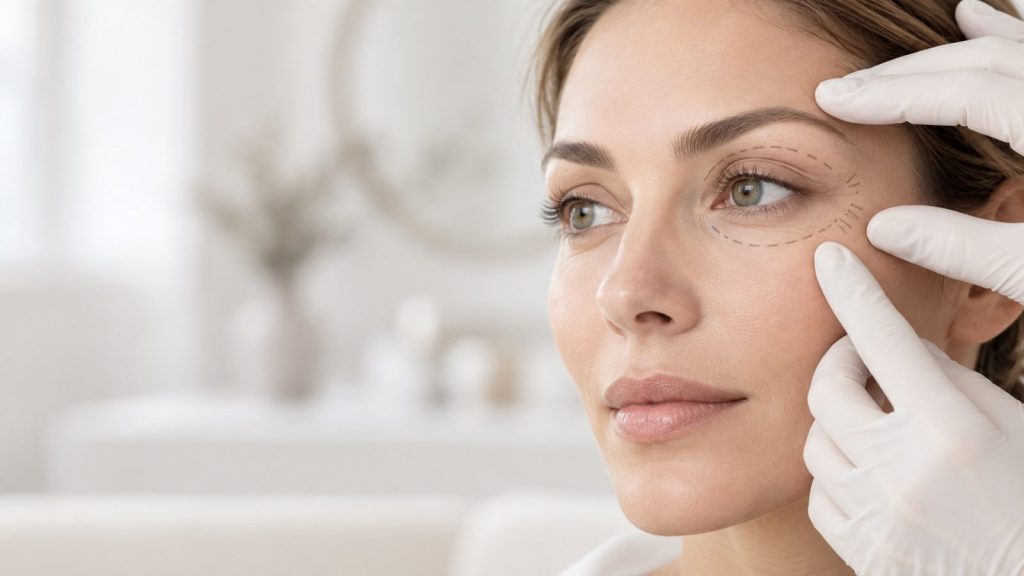
Lower blepharoplasty focuses beneath the eyes. It may address prominent eye bags, protruding fat, selected excess skin and changes in the relationship between the lower eyelid and cheek.
Some patients have concerns affecting both regions. Others need treatment to only one.
For patients researching blepharoplasty london, understanding why the eye area looks heavy or tired is therefore more important than simply deciding that eyelid surgery is needed.
DRV Clinic provides consultations from its Baker Street clinic in Marylebone, Central London. The identity and credentials of the operating surgeon, surgical facility, anaesthetic plan and aftercare pathway should be confirmed before proceeding with surgery.
Blepharoplasty at a Glance
Question | Quick answer |
What is blepharoplasty? | Surgery involving selected tissues of the upper or lower eyelids |
Upper blepharoplasty mainly treats | Excess upper-eyelid skin and selected fat or tissue |
Lower blepharoplasty mainly treats | Eye bags, selected protruding fat and lower-eyelid skin concerns |
Can both be performed? | Yes, in suitable patients |
Does blepharoplasty correct every drooping eyelid? | No – brow descent and true eyelid ptosis may require different assessment |
Is it the same as non-surgical blepharoplasty? | No |
Typical time away from work | NHS guidance says many people allow around 2 weeks |
Current DRV upper price | £2,000 |
Current DRV lower price | £2,500 |
Current DRV upper + lower price | £3,750 |
What Is Blepharoplasty?
For people searching what is blepharoplasty, it is surgery used to alter selected skin, fat and other tissues around the eyelids.
The NHS describes eyelid surgery as a cosmetic procedure used to remove excess skin or fat from the eyelids and explains that it can alter hooded or drooping eyelids and eye bags.
Read the NHS guide to eyelid surgery
At DRV Clinic, the current treatment offering includes upper, lower and combined surgical blepharoplasty.
View DRV Clinic’s Blepharoplasty London page
Upper and lower surgery should not, however, be treated as interchangeable operations.
They involve different anatomy and address different concerns.
Upper vs Lower Blepharoplasty: What Is the Difference?
Concern | Upper Blepharoplasty | Lower Blepharoplasty |
Excess upper-eyelid skin | Often relevant | No |
Upper-eyelid hooding | May help where eyelid skin is the cause | No |
Under-eye bags | No | Often relevant |
Protruding lower-eyelid fat | No | May be addressed |
Loose lower-eyelid skin | No | May be addressed |
Brow descent | Does not directly lift the brow | No |
True upper-eyelid ptosis | Requires separate assessment | No |
Concerns affecting both eyelids | May form part of combined surgery | May form part of combined surgery |
The NHS explains that upper-eyelid surgery generally involves an incision within the natural eyelid crease followed by removal of selected excess skin, fat or muscle.
Lower surgery may use an incision just beneath the eyelashes or on the inside of the lower eyelid. Fat contributing to eye bags can be repositioned or removed, and selected skin or supporting structures may also be addressed where required.
The operative plan should be based on the individual anatomy rather than the treatment name alone.
Upper Blepharoplasty: What Does It Treat?
Upper blepharoplasty is primarily concerned with the upper eyelid.
With ageing, skin and deeper tissues change. Excess skin may gradually fold over the natural eyelid crease, making the eye area look heavier or more hooded.
Upper blepharoplasty may be considered for concerns such as:
- excess upper-eyelid skin;
- pronounced hooding caused by eyelid tissue;
- reduced visibility of the natural eyelid crease;
- selected fatty prominence;
- asymmetry that may be surgically addressable;
- significant tissue affecting the upper visual field in appropriately assessed cases.
The important qualification is that not every hooded-looking eye is caused by excess eyelid skin.
Hooded Eyelids, Brow Descent and True Ptosis Are Different
This distinction is particularly important before upper eyelid surgery.
Three problems can look superficially similar:
Excess eyelid skin
The upper eyelid itself contains redundant skin that folds over the crease.
This is the type of issue that upper blepharoplasty may directly address.
Brow descent
The eyebrow can gradually sit lower with age, pushing tissue beneath it towards the eyelid.
BAAPS explains that eyebrow position has a direct effect on the appearance of the upper lid and that blepharoplasty does not itself raise the brow. Where brow descent contributes substantially to hooding, eyelid surgery alone may not completely correct the appearance.
True eyelid ptosis
Ptosis refers to an abnormally low position of the upper eyelid itself and can involve the mechanism responsible for lifting the eyelid.
This is not simply excess skin.
BAAPS notes that an underlying problem with the eyelid-opening mechanism may occasionally become more apparent following removal of excess upper-lid skin.
True ptosis may therefore require separate ophthalmic or surgical assessment and should not automatically be assumed to improve with standard blepharoplasty alone.
This is why an eye that looks “droopy” should be assessed before deciding which operation is appropriate.
What Does Lower Blepharoplasty Treat?
Lower blepharoplasty focuses on the area beneath the eye.
One of the most common reasons patients consider the operation is persistent eye bags that remain visible regardless of sleep.
These may develop when fat within the eye socket becomes more prominent. Skin laxity and changes to supporting tissues can contribute as well.
Depending on the anatomy, lower blepharoplasty may address:
- prominent under-eye bags;
- selected protruding fat;
- excess lower-eyelid skin;
- changes to the lower-eyelid contour;
- selected age-related changes in the lid-cheek region.
The NHS explains that lower-eyelid surgery may involve repositioning or removing fat and, where appropriate, addressing skin and the supporting structures of the eyelid.
A lower blepharoplasty is not simply an upper blepharoplasty performed underneath the eye.
The anatomy, surgical planning and potential complications differ.
Eye Bags vs Tear Trough Hollows
These concerns are often confused.
An eye bag creates a convex bulge.
A tear trough creates a depression or hollow.
Someone can also have both.
That distinction changes the treatment.
Adding filler beneath a substantial eye bag does not remove protruding fat and may make the under-eye region look heavier. Conversely, surgery may be more than is required when the concern is primarily a mild volume-related hollow without significant fat protrusion or loose skin.
A useful under-eye assessment therefore distinguishes:
hollowing
from
bulging
from
skin laxity
from
pigmentation.
The treatment should follow the anatomy rather than the label “dark circles”.
For patients whose main concern is structural hollowing rather than bags, see our Tear Trough Filler London guide.
Who May Be Suitable for Blepharoplasty?
Suitability depends on more than age.
Assessment may include:
- distribution of excess skin;
- presence and position of fatty prominence;
- brow position;
- true eyelid position;
- lower-eyelid support;
- facial and eyelid symmetry;
- dry-eye symptoms;
- previous eye surgery;
- visual symptoms;
- general medical history;
- medication;
- smoking;
- expectations of surgery.
The NHS advises patients to consider whether a medical condition may be affecting the eyelids and notes that results cannot be guaranteed.
Cosmetic eyelid surgery should therefore begin with diagnosis of the aesthetic concern rather than an assumption about the operation required.
Can Upper and Lower Blepharoplasty Be Performed Together?
Yes, in suitable patients.
Someone may have substantial upper-eyelid hooding alongside lower-eye bags, making combined surgery reasonable.
But having ageing changes around both eyes does not automatically mean both eyelids require surgery.
If the concern is predominantly upper-eyelid skin, unnecessary lower surgery adds additional intervention without addressing a meaningful problem.
The reverse is equally true.
Each proposed procedure should have a clear anatomical reason.
Surgical vs Non-Surgical Blepharoplasty
Surgical and non-surgical blepharoplasty are not different strengths of the same treatment.
Surgical blepharoplasty physically removes or repositions selected tissue.
Non-surgical blepharoplasty does not surgically remove excess skin or fat and is intended for more limited concerns.
DRV Clinic’s current non-surgical guidance positions the treatment for selected patients with mild-to-moderate eyelid laxity or early hooding, while significant excess skin, prominent fat or more advanced structural heaviness may require surgical assessment.
Read DRV Clinic’s Non-Surgical Blepharoplasty guide
This distinction is important when comparing both price and expected results.
A non-surgical treatment priced in the hundreds and a surgical procedure costing several thousand pounds should not be presented as interchangeable alternatives.
What Happens During Upper Blepharoplasty?
The specific operation varies according to the patient’s anatomy and surgeon’s plan.
In general, upper-eyelid surgery involves an incision placed within the natural eyelid crease.
Selected excess skin and, where appropriate, fat or other tissue may then be removed or repositioned before the incision is closed.
The NHS notes that the scar is usually positioned within the natural fold of the upper eyelid.
The amount of tissue removed matters.
More is not necessarily better.
The eyelids still need to close comfortably and protect the eyes.
What Happens During Lower Blepharoplasty?
Lower blepharoplasty can be approached in different ways.
The NHS describes incision placement either just beneath the lower eyelashes or through the inside of the lower eyelid.
Selected fat may then be repositioned or removed. Skin and supporting structures may also be addressed where clinically appropriate.
The correct technique depends on factors such as fat prominence, skin laxity, eyelid support and the relationship between the lower lid and cheek.
Patients should therefore ask their operating surgeon which technique is proposed and why.
Blepharoplasty Before and After: What Should You Compare?
Blepharoplasty before and after photographs can be useful, but only when they are interpreted properly.
For upper blepharoplasty, useful features to compare include:
- amount of hooding;
- visibility of the natural eyelid platform;
- upper-lid symmetry;
- relationship between the brow and eyelid;
- whether the result still looks natural when the eyes are open.
For lower blepharoplasty, look at:
- projection of the eye bags;
- smoothness of the lid-cheek transition;
- lower-lid position;
- skin contour;
Photographs should ideally use similar lighting, facial expression, head position and camera distance.
A raised eyebrow in an “after” photograph can make upper-eyelid surgery appear more dramatic than it actually is.
How Long Is Blepharoplasty Recovery?
Recovery varies between patients and according to whether upper, lower or combined surgery has been performed.
The NHS states that many people allow approximately two weeks away from work, depending on their occupation.
Bruising and redness may remain visible for several weeks, while scars can remain noticeable or feel tight for months as they mature.
Temporary effects may include:
- swelling;
- bruising;
- watery or sensitive eyes;
- numbness;
- tightness;
- temporary difficulty fully closing the eyelids;
- visible incision lines.
Two weeks away from work does not mean complete healing in two weeks.
The eye area continues settling after patients resume normal daily activity.
When Can I Sleep on My Side After Blepharoplasty?
Semrush research shows that when can i sleep on my side after blepharoplasty is a meaningful patient query.
There is no universal day that is appropriate for everyone.
During early recovery, the NHS recommends resting with the head raised on pillows for the first couple of days to help reduce swelling.
When normal side sleeping can resume depends on the procedure, swelling, wound healing and the surgeon’s instructions.
The specific post-operative plan should take priority over a timetable found online.
How Long Does Blepharoplasty Last?
Blepharoplasty can produce a long-lasting structural change because selected tissue has been surgically removed or repositioned.
But surgery does not stop ageing.
Skin quality, brow position, facial volume and surrounding tissues continue to change over time.
A result may therefore remain visible for years while the eye area continues to age naturally.
The operation should not be described as making the eyelids permanently resistant to ageing.
Does Blepharoplasty Leave Scars?
Yes.
An incision creates a scar.
For upper blepharoplasty, the incision is usually positioned within the natural eyelid crease.
For external lower blepharoplasty, the incision may be positioned close to the lash line. Some lower-lid operations instead use an incision on the inside of the eyelid.
The NHS states that scars should gradually fade and may become difficult to see, although they can remain visible and tight during the earlier healing period.
“Scar-free blepharoplasty” is therefore not an appropriate promise for surgical eyelid treatment.
What Are the Risks of Blepharoplasty?
All surgery carries risk.
Common temporary effects such as swelling and bruising should be distinguished from complications.
The NHS lists recognised problems following blepharoplasty including blurred or double vision, asymmetry, noticeable scarring and altered eyelid sensation.
Rare but more serious complications can include injury to the eye muscles, lower-eyelid ectropion, bleeding within the eye socket and visual impairment.
General surgical risks such as bleeding, infection, blood clots and reactions to anaesthesia also apply.
The operating surgeon should explain which complications are relevant to the proposed operation, how common they are in their practice and what would happen if they occurred.
Discussing risk does not mean complications are expected.
It means this is surgery and should be consented as surgery.
How Much Does Blepharoplasty Cost in London?
Blepharoplasty cost varies according to the operation, surgeon, surgical facility, anaesthesia, follow-up and whether the upper eyelids, lower eyelids or both are treated.
DRV Clinic’s current central price list states:
Surgical Treatment | Current Listed Price |
Blepharoplasty – Upper | £2,000 |
Blepharoplasty – Lower | £2,500 |
Blepharoplasty – Upper + Lower | £3,750 |
These are the current figures on DRV Clinic’s main pricing page and should be reconfirmed during consultation before surgery is booked.
View the current DRV Clinic price list
The NHS gives a broader UK guide of approximately £2,000 to £6,000 and advises patients to consider consultation, follow-up and any additional surgery that may be required.
A surgical quote should make clear what is included.
Price should not be assessed separately from the operating surgeon, surgical facility, anaesthesia and follow-up arrangements.
Blepharoplasty Near Me: How Should I Choose a Provider?
For someone searching blepharoplasty near me, location should not be the deciding factor.
This is an operation.
The NHS states that independent clinics and hospitals providing cosmetic surgery in England must be registered with the Care Quality Commission (CQC). It also advises patients to research the surgeon or ophthalmologist performing the procedure and confirms that doctors must, at minimum, be registered with the General Medical Council (GMC).
Before booking, establish:
- the full name of the operating surgeon;
- their professional qualifications;
- their GMC registration;
- their experience performing upper or lower blepharoplasty;
- which CQC-registered facility will be used for the surgery;
- which type of anaesthesia is proposed;
- who provides the anaesthesia where relevant;
- what the quoted price includes;
- what follow-up is provided;
- who to contact after surgery;
- what happens if a complication develops.
The NHS notes that blepharoplasty may be performed under either local or general anaesthesia. The appropriate plan depends on the operation and clinical circumstances.
Patients should therefore receive the exact surgical and anaesthetic plan before consenting.
Blepharoplasty Consultations at DRV Clinic London
DRV Clinic is located at 1st Floor, 136 Baker Street, London W1U 6UD, in Marylebone. The address and current surgical prices are listed on DRV Clinic’s main pricing page.
For patients researching blepharoplasty london, an assessment should determine whether the concern arises predominantly from:
- excess upper-eyelid skin;
- brow descent;
- true eyelid ptosis;
- lower-eyelid fat;
- skin laxity;
- tear trough hollowing;
- or a combination of these.
The consultation should also establish whether upper, lower, combined or no surgery is appropriate.
Before booking surgery, patients should additionally be given the name and credentials of the operating surgeon, the location of the CQC-registered surgical facility, the proposed anaesthetic plan and the post-operative follow-up pathway.
Patients with milder eyelid laxity who do not need structural surgery may also discuss whether a non-surgical approach is relevant.
The correct treatment is not necessarily the most invasive one.
It is the one that addresses the structure actually causing the concern.
Frequently Asked Questions
What is blepharoplasty? It is eyelid surgery involving selected skin, fat or other tissues of the upper or lower eyelids.
Upper blepharoplasty primarily addresses selected upper-eyelid skin and tissue. Lower blepharoplasty focuses beneath the eye and may address eye bags, selected fat and lower-eyelid skin or supporting structures.
No. Hooding may result from excess eyelid skin or brow descent. True ptosis involves the position or lifting mechanism of the upper eyelid itself and may require separate assessment.
No. BAAPS specifically notes that blepharoplasty does not directly correct brow position. Where brow descent contributes significantly to hooding, a different or additional treatment may need to be discussed.
Yes, where there are appropriate concerns affecting both regions and the operating surgeon considers combined surgery suitable.
DRV Clinic's current central price list states £2,000 for upper blepharoplasty, £2,500 for lower blepharoplasty and £3,750 for combined upper and lower surgery. Prices should be confirmed before booking.
Recovery varies. NHS guidance states that many patients allow approximately two weeks away from work, although bruising, swelling and scar maturation continue beyond this period.
The structural change can be long-lasting, but surgery does not stop the natural ageing process.
Yes. Surgical incisions create scars, although they are generally positioned within natural creases or close to the lash line where appropriate so they may become less conspicuous with time.
Lower surgery may reduce selected eye bags by removing or repositioning prominent fat and addressing other lower-eyelid tissues where clinically appropriate.
There is no universal day. Patients should follow the individual instructions of their operating surgeon. Head elevation is commonly recommended during the early recovery period.
No. Surgical blepharoplasty physically removes or repositions selected tissue. Non-surgical treatment is more limited and cannot reproduce every structural change achievable through surgery.
Considering Blepharoplasty in London?
Upper and lower blepharoplasty address different anatomy.
Upper surgery may help where excess eyelid tissue is producing genuine hooding.
Lower surgery may address selected eye bags, prominent fat and lower-eyelid contour changes.
Yet a heavy-looking eye can also be influenced by brow descent, true ptosis or under-eye hollowing – problems that are not automatically corrected by standard blepharoplasty.
For patients researching blepharoplasty london, consultations are available through DRV Clinic in Baker Street, Marylebone.
Before proceeding, the surgical plan should clearly identify what is being treated, who will perform the operation, where it will take place, which anaesthetic approach is proposed and how follow-up will be managed.
Eyelid surgery should not begin with choosing upper or lower.
It should begin with understanding why the eyelid looks the way it does.

